
Shirshin Electronic Solutions
Full-cycle contract electronics development: from concepts and circuit design to production launch.

Our areas of expertise

Simulation modeling
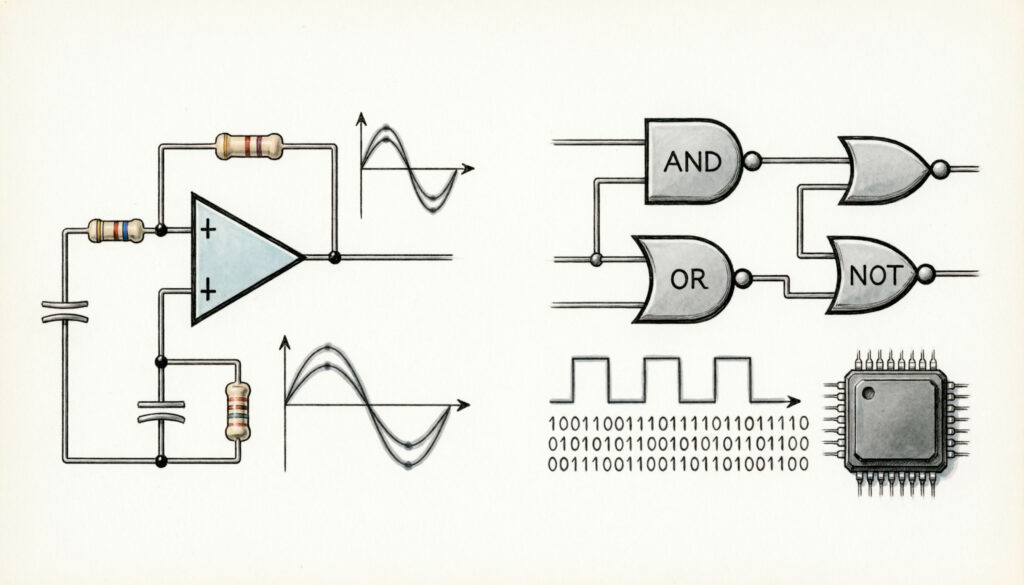
Analog and Digital Circuit Design

Power electronics

Electric drives

Embedded software
Microcontroller programming

Printed Circuit Board (PCB) Design

Production of prototypes

Preparation of documents for production

Release of the series
Operating procedure

The First Step
Preparation of technical specifications
A technical specification translates your idea from your head into clear instructions for the engineer. Without it, the developer will do what they think is right, rather than what you actually need.
Any changes or “wish-list” additions made once the board is already produced cost dozens of times more than simply editing a line in the document at the start. The specification locks in the requirements right from the outset.
Second step
Model development
The model makes it possible to test how the circuit behaves under conditions such as overheating, voltage spikes, or short circuits. It is far better to spot an error on a monitor screen than to have the finished board burn out in your hands. Every physical prototype entails costs and time—ordering boards, soldering, and component delivery. A simulation model allows you to identify and fix 90% of errors while still in the digital design phase, minimizing the need for costly rework.

Third step
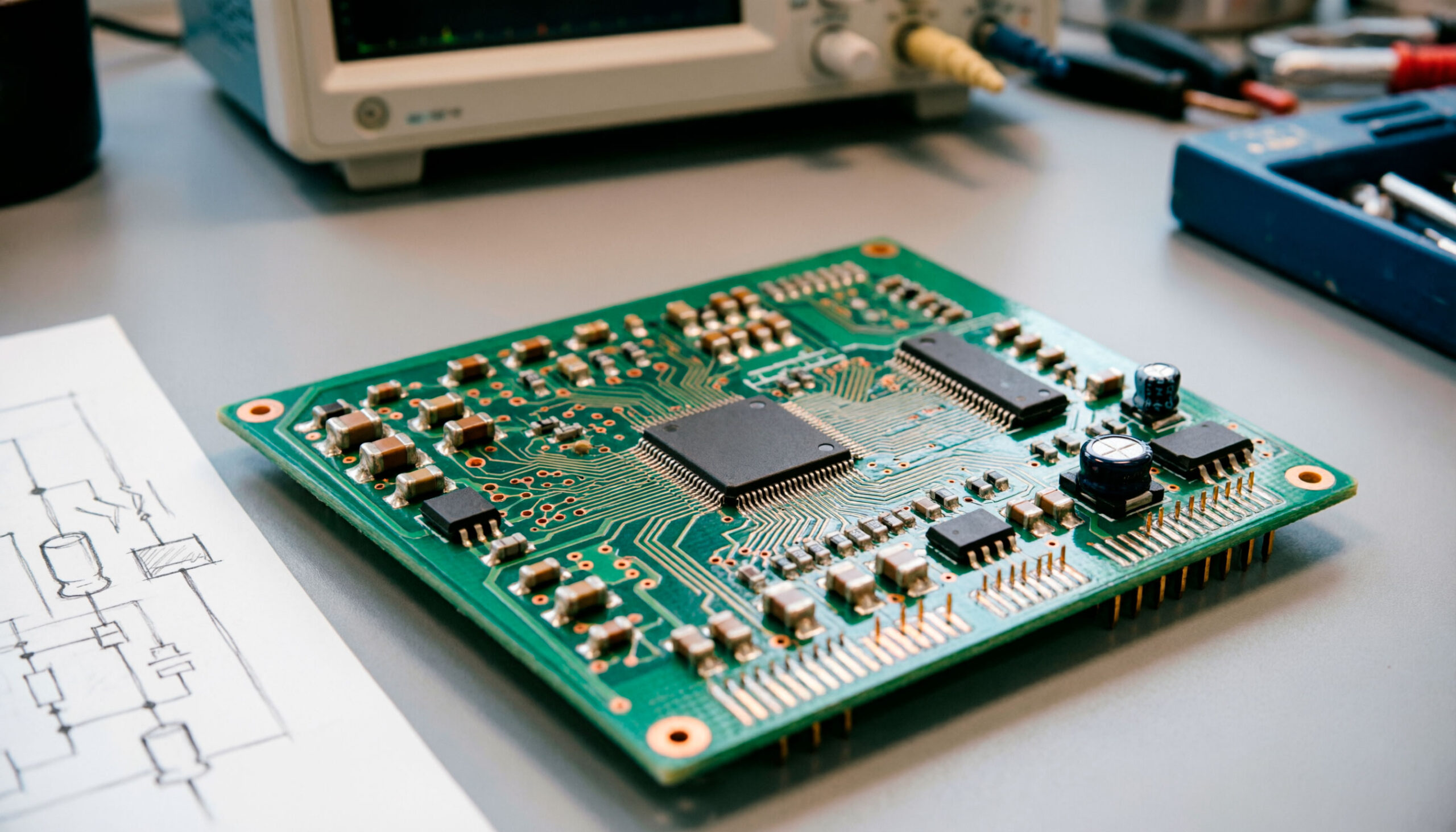
Schematic and PCB
A schematic diagram (or logic) is the “blueprint” showing how components are interconnected and how current flows through them. Without it, assembling the device is merely a matter of randomly poking parts together; the schematic ensures the device is actually capable of performing its intended function.
The printed circuit board (PCB) serves as the device’s “skeleton and nervous system.” It transforms the circuit from a tangle of wires into a compact, reliable, and advanced product that can be mass-produced in the thousands.
Fourth step
Prototyping
No computer simulation—even a perfect one—can account for every physical nuance: real-world signal interference, parasitic coupling, component heating, or how the device feels in the hand. A prototype demonstrates whether the concept works in the real world.


Fifth step
Testing
The device must function not only on an engineer’s desk under ideal conditions but also in freezing cold and extreme heat, and withstand drops and vibration. Climatic and mechanical tests reveal vulnerabilities—such as issues with soldering, overheating, or the casing—that are not apparent during standard operation. The electronics must not pose a shock hazard, spontaneously catch fire, or interfere with other radio signals. Without passing rigorous tests (for electromagnetic compatibility and electrical safety), the product will not receive the mandatory certifications and cannot legally be sold in stores.
Step Six
Series
Serial production marks the moment when a development ceases to be merely a “piece of hardware on a desk” and becomes a business that generates stable revenue and solves user problems on a mass scale.
Our advantages
Intellectual property protection and signing a non-disclosure agreement
During the development process, you share your schematics, code, and business plans with contractors, programmers, and manufacturers. A non-disclosure agreement (NDA) legally prohibits them from using this data for their own purposes or sharing it with competitors. Registering patents and copyrights secures exclusive rights to the technology for you. This prevents competitors from simply copying your circuit board and transforms your development into a valuable asset that significantly boosts the company’s overall value.
DFM approach
An engineer might design a perfect circuit board, but the factory could charge an exorbitant fee to assemble it due to non-standard components, unnecessary mounting holes, or the need for complex manual soldering. DFM optimizes the design for standard manufacturing processes, minimizing the cost of each unit produced. It accounts for the physical limitations of factory robots and reflow ovens, ensuring a high yield of functional boards right from the very first batch.
Laboratory
Having your own laboratory transforms routine debugging from a process involving long waits into a rapid internal workflow, significantly accelerating time-to-market while reliably protecting your secrets.
Protection against EKB deficiency
Safeguarding against shortages of electronic components is critical, as it acts as insurance for your business against a complete production halt caused by the absence of a single, low-cost part.
Full research and development cycle
The full research and development cycle is critically important because it offers the opportunity to manage the entire journey—from a raw idea to a mass-produced product—under one roof, avoiding any loss of quality or time at the hand-off points between contractors.